
KI-Regulierung als Wettbewerbsvorteil
Warum ISO 42001 und EU AI Act ein agentisches ERP-Projekt nicht stoppen müssen.
Ein MedTech-Unternehmen hatte ein agentisches ERP-System begonnen. Die Umsetzung lief. Dann kam die Frage aus der Geschäftsführung: Stoppen wir das?
Der Grund war nicht die Technik. Der Grund war die Regulierung. ISO 42001 und der EU AI Act, beide gleichzeitig, beide für ein Medizintechnik-Unternehmen. Die Sorge im Führungsteam: ein Bürokratiemonster. Viel Aufwand, lange Laufzeit, am Ende ein Projekt, das mehr Papier produziert als Nutzen.
Unser Auftrag war klar. Die Geschäftsführung wollte keine Vertröstung. Sie wollte eine belastbare Antwort: Bremst uns diese Regulierung wirklich aus – oder nicht? Wir haben die Frage ernst genommen und gründlich geprüft. Was wir dabei gelernt haben, ist die eigentliche Geschichte dieses Beitrags.
Die falsche Frage und die richtige
Das Führungsteam fragte: Wie viel Bürokratie kommt auf uns zu? Das ist verständlich. Aber es ist die falsche erste Frage.
Die richtige Frage lautet: Welche KI betreiben wir überhaupt – und ist davon etwas Hochrisiko? Denn der EU AI Act knüpft Pflichten an Risikoklassen. Wer keine Hochrisiko-KI betreibt, hat einen ganz anderen Aufwand als wer es tut.
Der erste Schritt war deshalb keine Richtlinie und kein Schulungskonzept. Es war eine nüchterne Bestandsaufnahme: eine KI-Inventur. Welche Systeme sind im Einsatz? Wo? Und fällt etwas davon unter Hochrisiko?
Diese Inventur dauert in einem typischen mittelständischen Unternehmen wenige Wochen. Sie liefert zwei Ergebnisse. Erstens: Man weiß, worüber man redet. Zweitens, und das ist die häufigste Überraschung: Die eingesetzten Systeme fallen meist nicht unter Hochrisiko. Das nimmt Druck heraus.
Warum die Regulierung das Projekt nicht killt
Es gibt ein verbreitetes Missverständnis: ISO 42001 und EU AI Act seien zwei getrennte Projekte. Das stimmt nicht.
Normen sind freiwillig, Gesetze sind Pflicht. Beide lassen sich aber verbinden: Für jene Bereiche, die der EU AI Act regelt, entstehen derzeit sogenannte harmonisierte Normen, im Auftrag der EU erarbeitet und später im Amtsblatt der Union veröffentlicht. Wer eine solche Norm anwendet, profitiert von der Konformitätsvermutung: Die Behörden gehen dann davon aus, dass die gesetzlichen Anforderungen erfüllt sind, solange nichts Gegenteiliges nachgewiesen wird. Das kehrt die Beweislast um, ein erheblicher praktischer Vorteil. Für das KI-Managementsystem entsteht eine solche harmonisierte Norm gerade unter der Bezeichnung EN 18286.
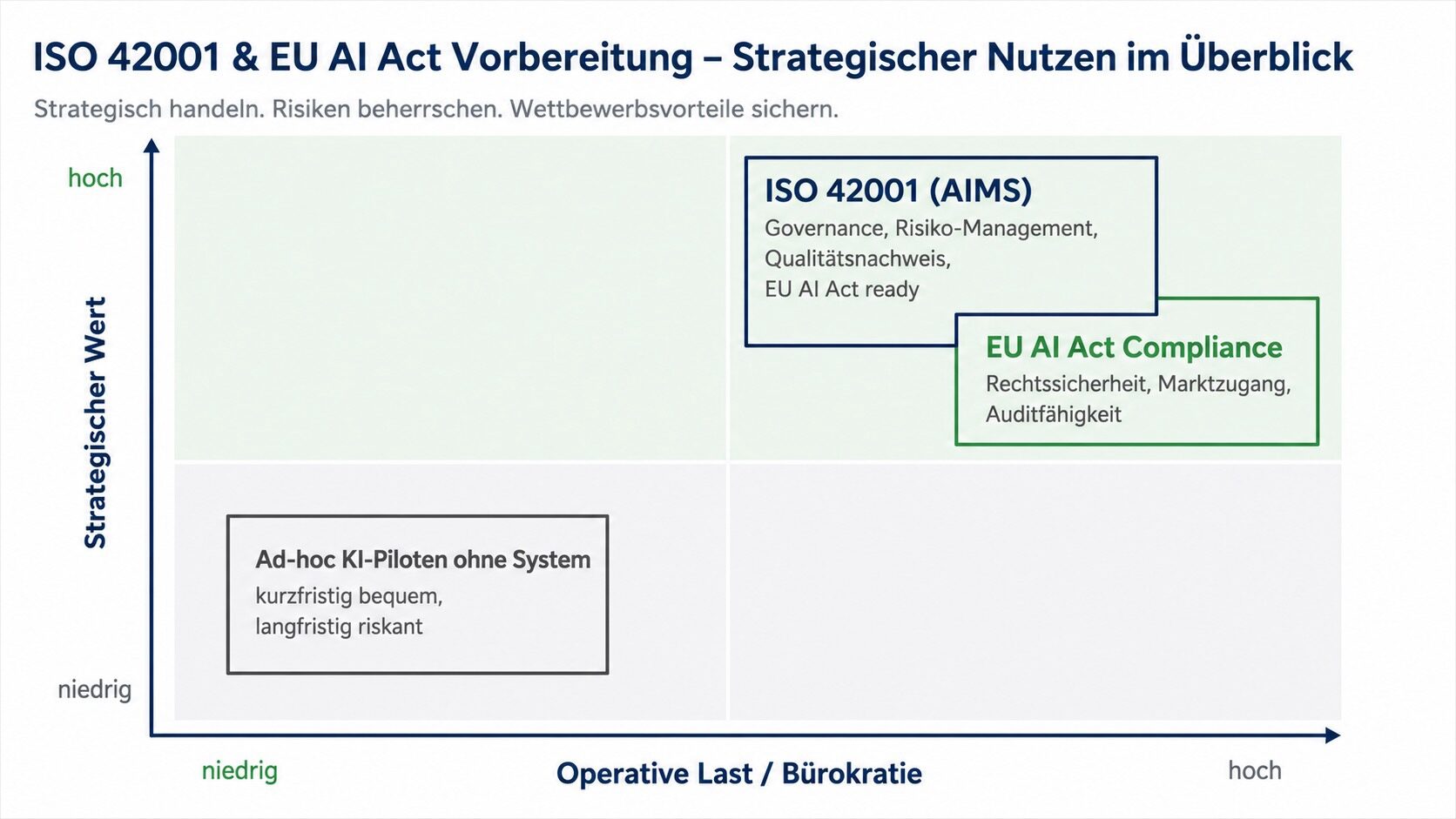
ISO 42001 ist keine mandatierte Norm. Aber sie ist die direkte Vorstufe. Wer heute ein KI-Managementsystem in Anlehnung an ISO 42001 aufbaut, legt genau den Rahmen, den morgen EN 18286 und der AI Act verlangen. Man baut nicht zweimal. Man baut einmal – und richtig.
Genau das hat dem MedTech-Führungsteam die Sorge genommen. Die Regulierung war kein zweiter Berg. Sie war derselbe Berg, von zwei Seiten beschrieben.
Sechs Bausteine, die beide Systeme teilen
In der Fachpraxis von Anja Nestler decken sich ISO 42001 und EU AI Act in den wesentlichen Anforderungen. Sechs Bausteine tauchen in beiden auf:
- Risikomanagement – KI-Risiken identifizieren, bewerten, kontrollieren (ISO 42001 Abschn. 6.1 · AI Act Art. 9).
- Dokumentation – transparente Unterlagen zu Systemen, Daten und Protokollen (Abschn. 7.5 · Art. 11).
- Daten-Governance – Datenqualität, Bias-Tests, Umgang mit sensiblen Daten (Anh. A.7 + B · Art. 10).
- Menschliche Aufsicht – wirksame Kontrolle durch Menschen sicherstellen (Anh. A.9 · Art. 14).
- Leistungsüberwachung – Genauigkeit, Robustheit, Validierung, Drift-Kontrolle (Abschn. 9 · Art. 15).
- Kontinuierliche Verbesserung – Betrieb beobachten, Vorfälle melden, aktualisieren (Abschn. 10 · Art. 72/73).
Wer die sechs Bausteine nach ISO 42001 umsetzt, deckt die zentralen Anforderungen des EU AI Act strukturell ab.
Weniger Zeitdruck als befürchtet
Zur Lage nach damaligem Stand: Über den sogenannten „Digital Omnibus on AI“ haben sich Rat und Europäisches Parlament im Mai 2026 auf Fristenverschiebungen verständigt. Das Parlament hat sie am 16. Juni 2026 bestätigt; die formale Annahme stand zu diesem Zeitpunkt noch aus. Die Daten sollten vor jeder Entscheidung am aktuellen Stand geprüft werden.
- Hochrisiko-KI, eigenständig (Annex III): vom 2. August 2026 auf den 2. Dezember 2027 verschoben.
- Hochrisiko-KI in Produkten (Annex I): vom 2. August 2027 auf den 2. August 2028.
- Nationale KI-Reallabore: vom 2. August 2026 auf den 2. August 2027.
- Transparenzpflichten / Kennzeichnung: hier wurde die Frist verkürzt, von sechs auf drei Monate.
Für ein eingebettetes Medizinprodukt zählt vor allem die zweite Zeile. Das verschafft Zeit. Aber Zeit nützt nur, wer sie nutzt – nicht, wer wartet.
Woher der Frust wirklich kommt
Compliance-Projekte scheitern selten an den Normen. Sie scheitern an drei organisatorischen Ursachen:
- Unklare Verantwortung. Trägt niemand im Führungsteam das Thema, wird es zur Daueraufgabe ohne Fortschritt.
- Fehlende unternehmerische Verankerung. Compliance, die nur „weil Brüssel es will“ läuft, bleibt ein Fremdkörper.
- Behandlung als Zusatzaufwand. Wer das Projekt neben dem Tagesgeschäft organisiert, schafft es nie. Es muss Teil der Führungsarbeit werden.
Alle drei sind behebbar. Sie verlangen keine Normenkenntnis, sondern Führungsentscheidungen.
Der praktische Weg
Im Projekt haben wir drei Hebel angesetzt:
- Verantwortung im Führungsteam klären. KI-Governance braucht einen Namen. Eine Person, die das Thema besitzt. Das kann die Geschäftsführung sein, die Leitung Digitalisierung oder ein Prokurist mit Mandat. Wichtig ist die klare Antwort auf: Wer trägt das bei uns?
- An echte Fragen andocken. Wer haftet, wenn unsere KI eine fehlerhafte Empfehlung gibt? Welche Kunden verlangen Nachweise zum KI-Einsatz? Haben wir Kontrolle über die KI-Tools, die Mitarbeiter täglich nutzen? Wenn die Antwort „wir wissen es nicht genau“ ist, ist Governance kein Bürokratieprojekt, sondern Risikovorsorge.
- Klein anfangen mit der KI-Inventur. Nicht mit dem vollen Apparat starten. Erst sehen, was da ist.
Darauf folgt ein Fahrplan über rund sechs Monate, in drei Phasen:
- Phase 1 (Monat 1–2): Lückenanalyse, KI-Governance definieren, Anwendungsbereiche festlegen, KI-Systeme erfassen, Risiken bewerten, Richtlinien erstellen.
- Phase 2 (Monat 3–4): Kontrollen umsetzen, Daten-Governance stärken, Dokumentation aufbauen, menschliche Aufsicht definieren.
- Phase 3 (Monat 5–6): interne Audits, Management-Review, Lücken schließen, Zertifizierungsvorbereitung prüfen.
PRODVIS und Partner: gemeinsam statt allein
PRODVIS begleitet mittelständische Unternehmen seit Jahren bei der digitalen Transformation, von der ERP-Einführung bis zur Integration von KI in operative Prozesse. Die technischen Fragen sind lösbar. Die organisatorischen sind die eigentliche Herausforderung.
Für die Verzahnung von KI-Governance und Normkonformität arbeiten wir mit spezialisierten Partnern. Anja Nestler, Dipl.-Ing. und systemische Organisationsberaterin, arbeitet mit Führungsteams im Mittelstand. Als zertifizierte Normungsexpertin kennt sie die Welt der Normen von innen – ihr Fokus liegt jedoch auf der Frage, die über Erfolg oder Scheitern solcher Vorhaben entscheidet: Trägt das Führungsteam das Thema wirklich? Ihr Ansatz: nicht Bürokratie abbilden, sondern Steuerungsfähigkeit aufbauen. Sie unterstützt dabei, KI-Governance und Compliance-Anforderungen so in der Führungsarbeit zu verankern, dass aus regulatorischem Druck unternehmerische Klarheit wird.
Die Aufteilung im Projekt war einfach. PRODVIS bringt die ERP-, Prozess- und Agenten-Perspektive. Anja Nestler bringt die organisatorische Seite: die Verankerung im Führungsteam, an der KI-Projekte sonst oft scheitern. Zusammen hält das ein KI-Projekt in Bewegung und macht Governance handhabbar. Wie das ERP dabei zum Governance-Layer für agentische KI wird, beschreiben wir in einem eigenen Beitrag.
Fazit: Governance ist keine Bremse
Das MedTech-Projekt lief weiter. Es wurde nicht gestoppt. Es wurde besser strukturiert.
Wer KI verantwortungsvoll einsetzt, kann gegenüber Kunden, Banken und Behörden belegen, dass die Systeme kontrolliert, dokumentiert und haftungsrechtlich abgesichert laufen. In einem Markt, in dem KI-Missbrauch zunehmend öffentlich wird, ist das kein Marketing-Argument. Es ist ein Unterschied.
Governance ist keine Bremse, wenn man sie früh integriert. Sie kann ein Wettbewerbsvorteil sein. Entscheidend ist nicht die Norm. Entscheidend ist, dass jemand im Führungsteam sie trägt – und dass man klein anfängt, mit einer KI-Inventur.
Klären wir, wo Ihr Unternehmen steht — mit einer KI-Inventur als erstem Schritt.
Wir prüfen gemeinsam, welche KI Sie betreiben, was davon regulatorisch relevant ist und wie Governance Ihr ERP-Projekt stärkt statt bremst.