
KI zwischen Europa, USA und China
Eine Orientierung für Mittelständler im DACH-Raum.
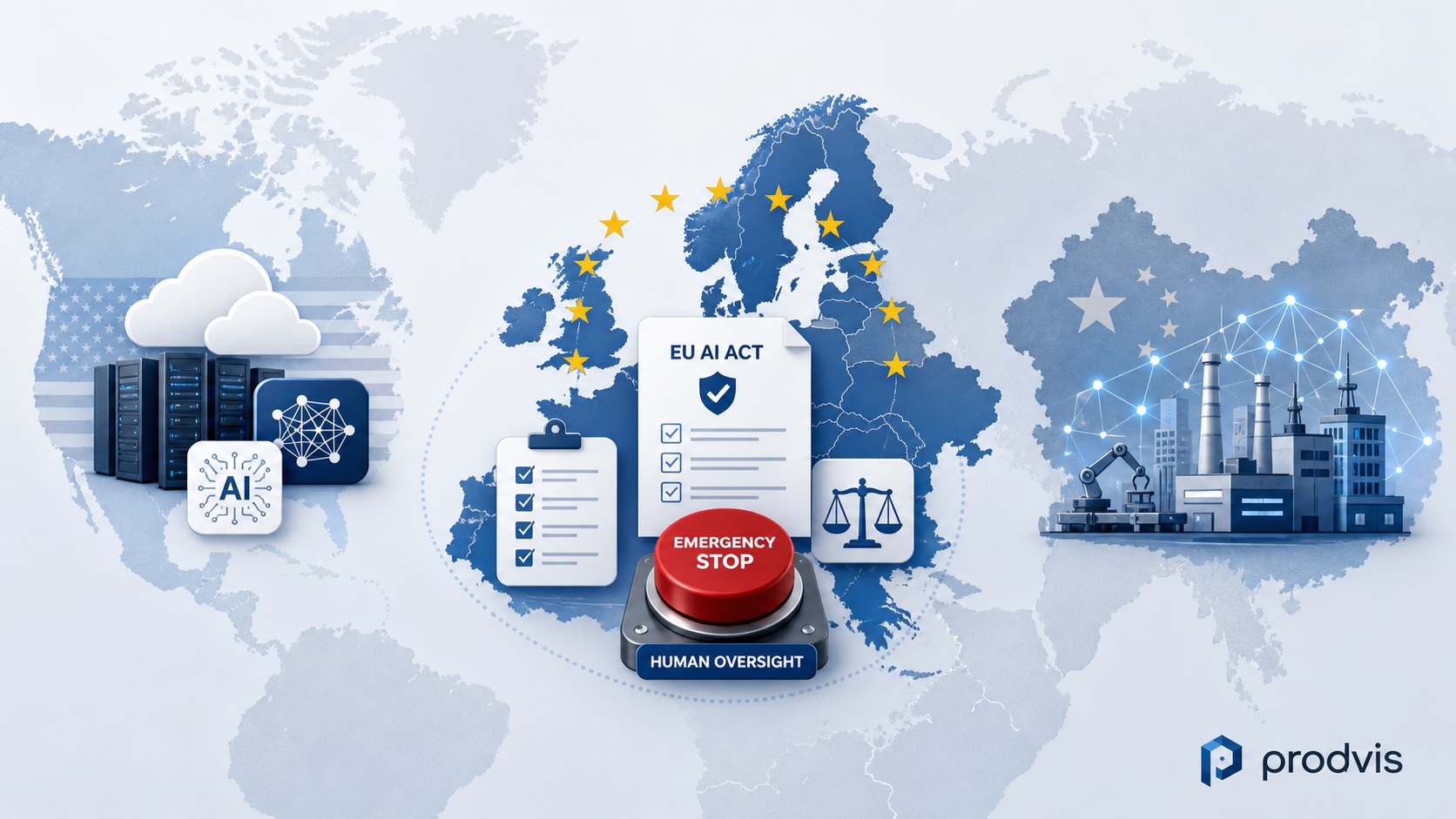
Silicon Valley erfindet, China kopiert, Europa reguliert. Für viele Mittelständler klingt das nach hämischer Resignation – irgendwo zwischen Bewunderung für die US-Innovationskraft, Sorge vor China und Genervtsein über Brüssel. Doch dieses Bild greift zu kurz. Europa baut vielleicht keine eigenen Hyperscaler oder Consumer-Smartphones, aber Europa besetzt das digitale Fundament: die Regeln, nach denen KI-Systeme in der Praxis eingesetzt werden dürfen.
Damit verschiebt sich die Frage für mittelständische Unternehmen im B2B-Handel und in der Produktion: Nicht mehr „Welche KI ist am cleversten?“, sondern „Welche KI kann ich rechtssicher, auditierbar und in meine Prozesse integriert betreiben?“.
Europa als Filter für vertrauenswürdige KI
Mit dem EU AI Act zieht Europa eine klare Grenze: Wer im EU-Binnenmarkt mit KI Geld verdienen will, muss sich an europäische Spielregeln halten – unabhängig davon, ob die Rechenzentren in Kalifornien, Dublin oder Singapur stehen. Entscheidend ist, wo die KI wirkt und wessen Daten verarbeitet werden.
Die Verordnung teilt KI-Anwendungen in Risikoklassen ein und legt für Hochrisiko-Systeme strenge Anforderungen fest – etwa bei Personalentscheidungen, Kreditvergabe, Qualitätsprüfung sicherheitsrelevanter Komponenten oder der Steuerung kritischer Infrastruktur. Vollautomatisierte „Blackbox“-Entscheidungen ohne menschliche Kontrollmöglichkeit sind damit passé. Gefordert werden dokumentierte Datenherkunft, nachvollziehbare Modelle und eine echte Human-in-the-Loop-Instanz.
Für den Mittelstand bedeutet das: Europa ist weniger „Herrscher über den Code“ als vielmehr Filter. Wer durch diesen Filter kommt, signalisiert: Diese Lösung ist nicht nur smart, sondern auch verantwortbar.
Was der AI Act für den Mittelstand wirklich verändert
Viele mittelständische Unternehmen in DACH stehen noch am Anfang der KI-Nutzung – oft mit Pilotprojekten, einzelnen Use Cases oder experimentellen Integrationen in bestehende Systeme. Mit dem AI Act kommen drei neue Realitäten hinzu:
- Beweislastumkehr: Wenn eine KI diskriminiert, fehlerhafte Entscheidungen trifft oder Schaden verursacht, muss das Unternehmen nachweisen, dass das System korrekt entwickelt und betrieben wurde.
- Dokumentations- und Governance-Pflichten: Datenherkunft, Trainingslogik, Monitoring und menschliche Eingriffsmöglichkeiten müssen konzeptionell und technisch verankert sein – nicht nur „für die Schublade“, sondern prüfbar.
- Compliance als Markteintrittskarte: Für viele Lieferketten – insbesondere Richtung OEMs und Großkunden – wird AI-Compliance Teil der Lieferantenanforderungen.
Gerade im B2B-Handel und in der Produktion treffen diese Regeln auf sensible Einsatzfelder: Preis- und Rabattlogik, Lieferantenbewertung, automatisierte Disposition, Qualitätsprüfung, Wartungsentscheidungen, HR-Auswahlprozesse. Was heute als „praktisches KI-Feature“ beginnt, kann schnell in die Kategorie Hochrisiko rutschen – mit entsprechenden Pflichten.
Warum ERP das Rückgrat der KI-Compliance wird
In vielen mittelständischen Unternehmen ist das ERP-System bereits heute der zentrale Ort für Stamm- und Bewegungsdaten: Artikel, Stücklisten, Kunden, Lieferanten, Preise, Aufträge, Bestände, Produktionsdaten. Genau hier liegt der Hebel, um KI-Compliance nicht als isoliertes Rechtsprojekt, sondern als integrierten Teil der Unternehmenssteuerung zu verankern.
Cloud-ERP plus KI bedeutet aus PRODVIS-Sicht:
- Single Source of Truth: KI-Modelle greifen strukturiert auf qualitätsgesicherte ERP-Daten zu, statt auf unkontrollierte Daten-Silos.
- Nachvollziehbarkeit: Entscheidungen der KI lassen sich entlang von Aufträgen, Belegen und Prozessketten auditierbar machen.
- Prozessintegration: KI arbeitet nicht „irgendwo daneben“, sondern innerhalb klar definierter Geschäftsprozesse mit definierten Freigaben, Rollen und Zuständigkeiten.
Damit verändert sich die Rolle des ERP-Systems: Vom reinen Transaktionssystem zum Governance-Layer für agentische KI im Unternehmen. Wie eine belastbare Cloud ERP für den Mittelstand & Exact Online Beratung diese Datenbasis schafft, beschreiben wir auf unserer Landingpage.
Agentische KI im Mittelstand: Vom Spielzeug zum Prozessakteur
Die aktuelle Generation agentischer KI-Systeme ist in der Lage, eigenständig Informationsquellen zu nutzen, Aktionen auszuführen und komplexe Aufgabenketten zu orchestrieren. Für B2B-Handel und Produktion heißt das konkret:
- Ein KI-Agent prüft Materialverfügbarkeiten, schlägt alternative Lieferanten vor und simuliert die Effekte auf Marge und Liefertermin – direkt im ERP-Kontext.
- Ein Service-Agent erstellt automatisch Wartungstickets, ordnet sie den richtigen Anlagen zu, plant Ressourcen vor und dokumentiert die Historie im System.
- Ein Vertriebs-Agent analysiert Bestellhistorien, identifiziert Cross- und Upselling-Potenziale und stößt abgestimmte Kampagnen an.
Diese Agenten arbeiten nicht „im luftleeren Raum“, sondern auf Basis klar definierter Rechte, Rollen und Freigabeprozesse – genau das, was der AI Act verlangt: menschliche Aufsicht, nachvollziehbare Entscheidungspfade und technische Kontrolle. Mehr dazu in unserem Beitrag zu agentischer KI im ERP für den Mittelstand.
PRODVIS: Vom ERP-Projekt zur KI-fähigen Prozessarchitektur
Unsere Positionierung als PRODVIS ist bewusst zweigleisig: Wir sehen Cloud-ERP und agentische KI nicht als getrennte Welten, sondern als zusammengehörige Architektur für den Mittelstand im DACH-Raum.
In Projekten mit B2B-Händlern und produzierenden Unternehmen gestalten wir drei Ebenen:
- Digitales Fundament: Cloud-ERP-Struktur. Saubere Stammdaten, kluge Prozessmodelle und ein klarer Schnittstellenbaukasten. Integration von Systemen wie Exact Online und angrenzenden Speziallösungen, um eine robuste Datenbasis zu schaffen.
- Agentische KI entlang realer Use Cases. Identifikation von KI-Szenarien mit echtem Business-Impact, zum Beispiel Bestandsoptimierung, Angebotsgenerierung oder Reklamationsmanagement. Konzeption und Umsetzung von KI-Agenten, die mit dem ERP „sprechen“ und Prozesse unterstützen statt ersetzen.
- AI Governance & Compliance by Design. Verankerung von AI-Governance im bestehenden Prozess- und Rollenmodell. Dokumentation von Datenflüssen, Entscheidungslogiken und menschlichen Eingriffspunkten. Vorbereitung auf die Anforderungen des EU AI Acts, ohne die Organisation mit reiner Regulierung zu überfrachten.
Unser Ziel: Aus „Wir probieren mal KI aus“ wird „Wir betreiben KI als integrierte, verantwortbare Prozesslogik in unserem ERP-System“.
Vom Risiko zur Chance: Wie Mittelständler das Spielfeld drehen
Europa zwingt Unternehmen, Verantwortung für KI zu übernehmen. Man kann das als Bürde sehen – oder als Chance, sich bewusst von „Schnellschuss-KI“ zu unterscheiden. Für den Mittelstand im B2B-Handel und in der Produktion eröffnet das drei konkrete Wettbewerbsvorteile:
- Vertrauensvorsprung bei Kunden und Partnern: Wer zeigen kann, wie KI-Entscheidungen zustande kommen und wie sie überwacht werden, schafft Vertrauen – gerade in langen, partnerschaftlichen Geschäftsbeziehungen.
- Bessere Skalierbarkeit: Sauber integrierte KI in klaren Prozessen lässt sich auf weitere Geschäftsbereiche, Standorte und Märkte ausrollen, ohne jedes Mal bei Null zu beginnen.
- Attraktivität als Arbeitgeber: Verantwortungsvolle, erklärbare KI stärkt die Akzeptanz bei Mitarbeitenden und eröffnet neue Rollenprofile, zum Beispiel „Process Owner AI“.
Nicht die lautesten KI-Demos werden sich durchsetzen, sondern diejenigen, die sich in den regulierten Alltag europäischer Wertschöpfungsketten einfügen.
Einladung: Vom Gespräch zur Umsetzung
Als PRODVIS Magazin sprechen wir bewusst nicht nur über Tools, sondern über das Zusammenspiel von Cloud-ERP, agentischer KI und Governance-Strukturen in mittelständischen Unternehmen.
Wenn Sie als B2B-Händler oder Produktionsunternehmen im DACH-Raum vor der Frage stehen, wie Sie:
- erste oder bestehende KI-Piloten AI-Act-fähig machen,
- Ihr ERP-System zum Steuerungszentrum für agentische KI entwickeln oder
- aus einzelnen Use Cases eine tragfähige, skalierbare KI-Prozessarchitektur machen möchten,
dann lassen Sie uns sprechen – gerne konkret entlang Ihrer bestehenden Systemlandschaft und Prozesse.
Machen wir Ihre KI AI-Act-fähig — entlang Ihrer Prozesse und Ihres ERP.
Wir prüfen gemeinsam, welche KI-Use-Cases sich rechtssicher, auditierbar und mit echtem Nutzen in Ihre Cloud-ERP-Landschaft integrieren lassen.