
20 percent use AI. The more important number is elsewhere.
What KfW figures mean for leadership teams in B2B trade and manufacturing.
 Tap image to enlarge
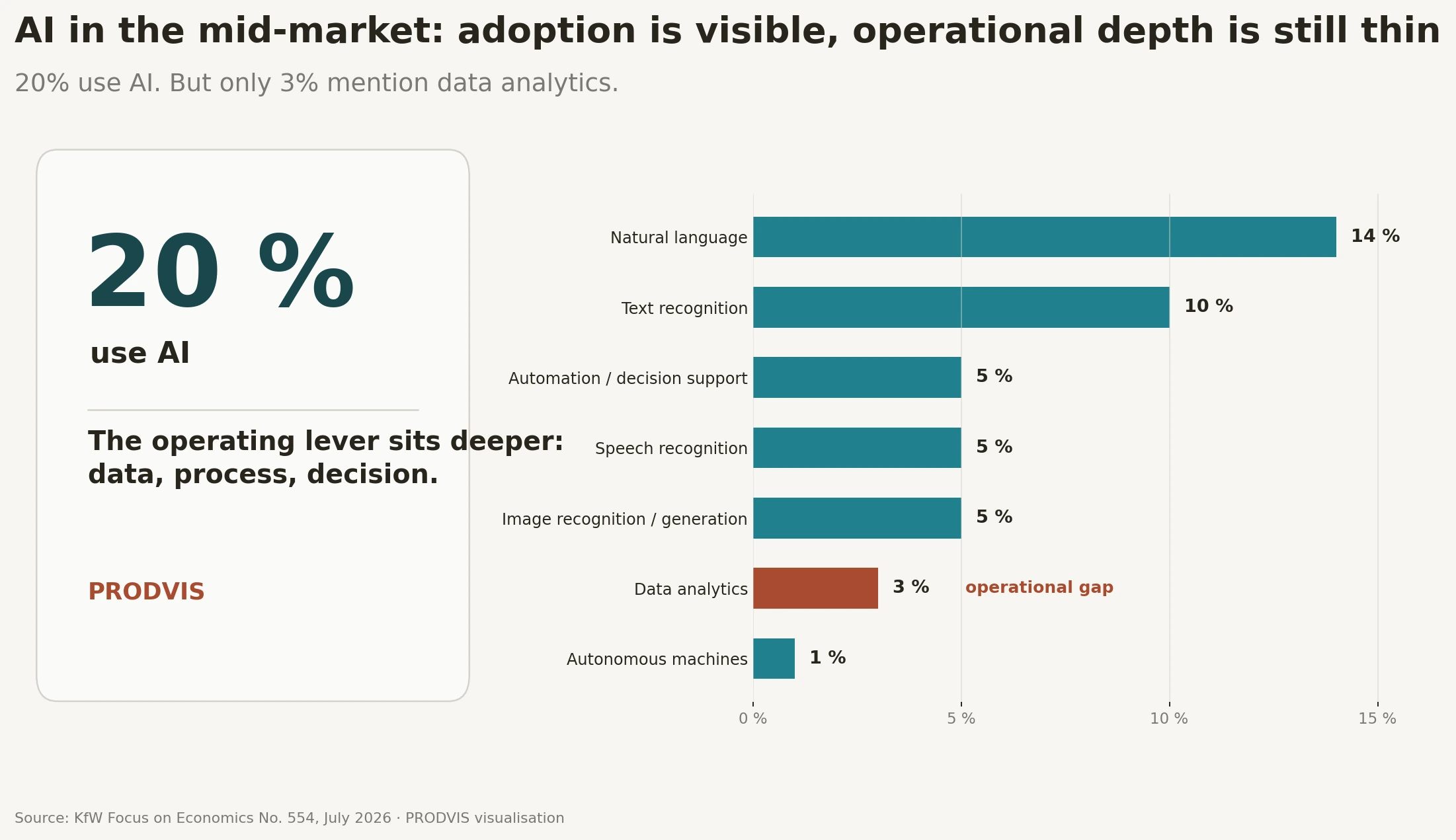
KfW reports a clear jump: between 2022 and 2024, one in five German mid-market companies used at least one AI technology. Between 2016 and 2018, the figure was around four percent. In absolute terms, KfW speaks of almost 780,000 companies. Among companies with more than 50 employees, the share is 36 percent. Source: KfW press release, 30 July 2026.
That is the headline. The more important number sits deeper in the study: 14 percent use AI to generate natural language. Ten percent use text recognition. But only three percent mention data analytics. For many trade and manufacturing companies, that is where operational value begins. Source: KfW Focus on Economics No. 554, July 2026.
The 20 percent figure measures adoption, not impact
Many companies now count as AI users because they write texts, prepare emails, create images or summarise documents. That is useful. It relieves daily work. But it does not automatically improve inventory, purchasing, sales, production, delivery reliability or margin.
For mid-market leadership teams, the better question is not: do we use AI? The better question is: where does AI touch an economically relevant process?
A digitalisation strategy is not paperwork. It is the filter.
KfW’s figures show a clear pattern. Companies with a digitalisation strategy use AI far more often than companies without digitalisation projects. This difference is practical, not academic. A strategy determines which tasks are worth automating, which data is needed and when a pilot should be stopped because it adds no value.
Data must be consumable. That is what ERP is for.
AI does not need a perfect world. But it needs understandable data. Customers, items, prices, inventory, delivery dates, invoices, complaints and open tasks must be available in a form that humans and, later, agents can work with.
This is where cloud ERP becomes relevant. A system such as Exact Online Premium is not just accounting or inventory management. Implemented properly, it becomes the consumable data foundation of the company.
Simple AI is the entry point. Operational AI is the work.
A text tool saves minutes. A well-connected AI agent can prepare recurring process work: check special items, structure documents, flag planning exceptions, prepare supplier requests or bring customer information together from ERP data.
The difference is not the model version. It is the process connection. Operational AI needs rules, approvals, data quality and clear accountability. Where liability, money or customer commitments are involved, humans remain in the decision point.
AI is a leadership topic. Otherwise it remains decoration.
The KfW figures are not a reason for euphoria and not a reason for fear. They are a signal: the mid-market has started. But most of the value is still ahead.
Leadership teams do not need to know every new tool. They need to know where better data, clear processes and prepared decisions create the biggest economic lever.
Five steps for the next leadership meeting
- Choose one lever: Where do errors, waiting time or manual rework visibly cost money today?
- Check the data foundation: Are items, customers, prices, inventory and documents reliable enough in ERP?
- Move the process with it: Who decides, who checks, who approves?
- Start small, measure hard: One process, one goal, one before-and-after metric.
- Build capability broadly: Do not only look for experts. Enable your own people.
Do not ask which AI tool is new. Ask where a better combination of data, process and decision creates the strongest economic lever in your company.
PRODVIS practice note
If you want to know where AI in your company is more than a useful text tool, we can start with a PRODVIS process check: 60 minutes, free of charge. One lever, the data foundation, the next sensible step. No sales pitch.
Sources and further reading
- KfW Focus on Economics No. 554: Artificial intelligence in the mid-market.
- KfW Focus on Economics No. 533: Artificial intelligence in the mid-market.
- KfW press release: artificial intelligence in the mid-market.
- Agentic AI in ERP for mid-market companies.
Created with AI support – reviewed by humans.