
Europe 2032: what is coming for the mid-market and PRODVIS
Six years. That is enough if you start now. For Europe. For the mid-market. And for every company that does not only want to test AI, but lead it.
2032 sounds far away. It is not. It is six years. One ERP migration and half of the next one. Roughly one and a half investment cycles in a mid-market company. Two German federal elections.
Enough time to do many things right. Or enough time to continue managing what is already breaking.
The PRODVIS briefing “Europe 2032” condenses scenarios, studies and market data. It does not ask whether Europe has a problem. That has been answered. It asks: what follows for the German Mittelstand?
The calculation Europe can no longer postpone
Mario Draghi showed in 2024 how large the gap has become. Europe’s per-capita income is clearly below the US level. In 2021, European companies invested around 270 billion euros less in research and development than US companies. Draghi therefore calls for additional investments of 750 to 800 billion euros per year (European Commission, EU factsheet on the Draghi report).
This is not doom writing. It is arithmetic. Whoever does not invest loses connection. Whoever loses connection loses room to act.
Other scenarios show the same pattern. The Bertelsmann Stiftung describes four paths for Europe up to 2035. The Konrad-Adenauer-Stiftung outlines scenarios between geopolitical order and fragmentation. The Istituto Affari Internazionali works with differentiation scenarios up to 2032. And the Arq scenario “Europe 2031” shows what happens if Europe keeps hesitating on AI compute and industrial sovereignty (Bertelsmann Stiftung, Konrad-Adenauer-Stiftung, IAI Rome, Arq Foundation).
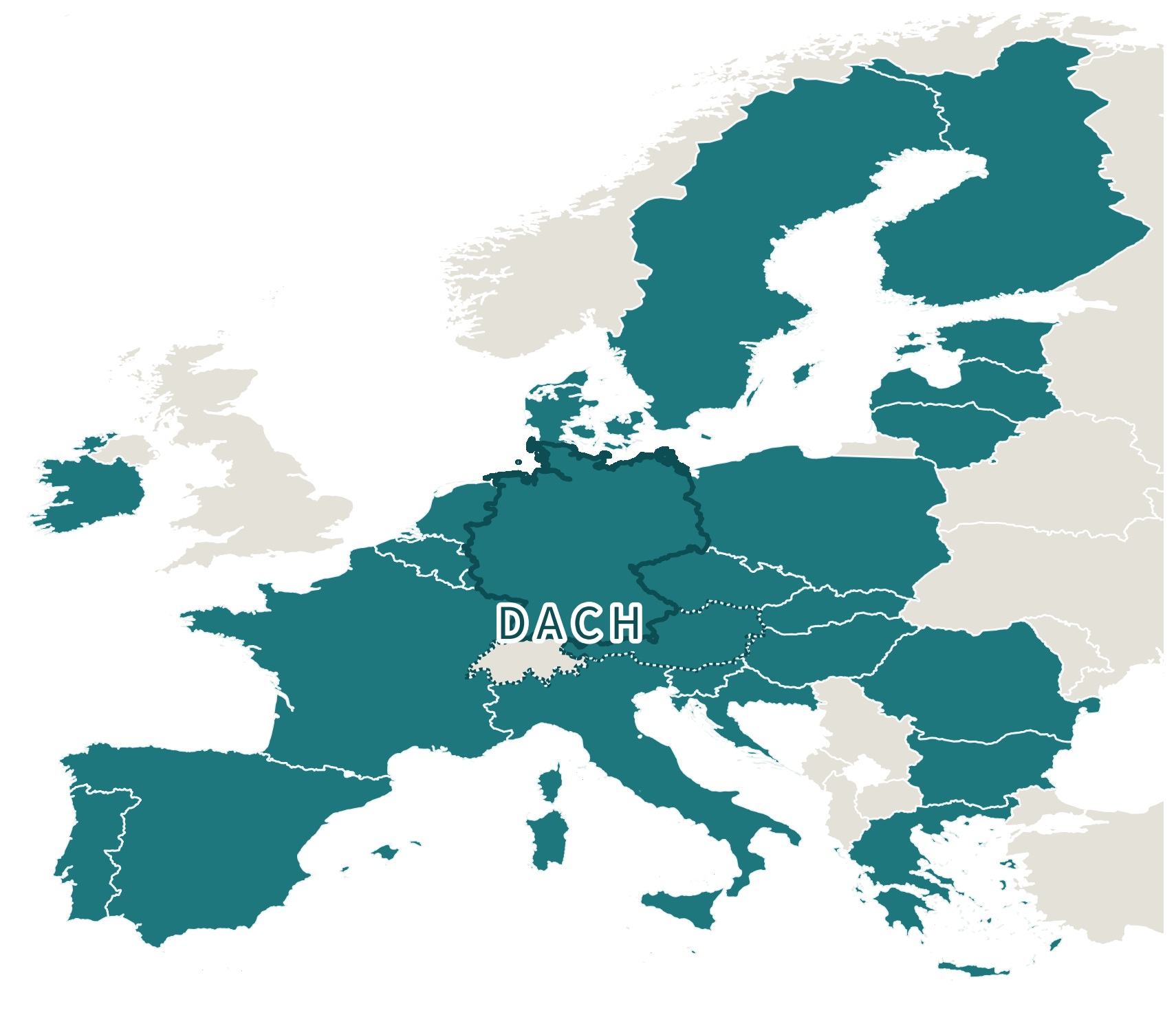
The German Mittelstand is at the fork in the road
The Mittelstand is not one part of the German economy. It is its operating system. Around 99 percent of all German companies belong to it (IW Köln).
At the same time, skilled people are missing. The BVMW points to study results showing that nine out of ten German mid-market companies are affected by the skills shortage (BVMW). Other surveys show a similar picture (Heidelberg / F.A.Z.-Institut).
Then comes the second gap. Larger mid-market companies can finance digitalisation. Smaller ones fall behind. The share of small companies in digitalisation spending fell clearly, while larger mid-market companies expanded their share (KfW Digitalisation Report Mittelstand 2024).
AI without strategy is becoming the new normal
Artificial intelligence is moving faster than many strategy processes. The KI-Index Mittelstand 2026 reports that 51.2 percent of mid-market companies use or test AI. The share of companies using AI agents is 16.6 percent (Deutscher Mittelstands-Bund / Salesforce).
That sounds like progress. It is progress. But there is a catch: many companies have no documented AI strategy. Employees load tools in the browser. Management finds out later.
This creates shadow agents. AI agents or AI identities that nobody has inventoried, nobody leads and nobody embeds into existing processes. For PRODVIS, this is not a side issue. It is the next governance gap in the mid-market.
Regulation is moving at the same time. The EU AI Act has been adopted. Transparency, documentation and risk obligations apply in stages (European Commission on the AI Act). Postponed is not solved. Companies that must repair in 2027 or 2028 what could have been ordered in 2026 will pay with time, money and trust.
What this means for PRODVIS
This is exactly the intersection where PRODVIS works. Not by accident. By mandate.
ERP is the trust base for every agent. An AI agent that triggers orders, checks invoices or plans inventory needs clean master data and clear processes. Without modern ERP, agentic AI remains a pilot without foundation.
Compliance becomes a sales argument. Mid-market companies do not need a legal catalogue. They need translated rules: what is allowed, what is risky and which evidence the company needs.
Governance comes before growth. Before the tenth AI agent starts, the first nine must be known. Not in an Excel list, but embedded in processes, roles and data ownership.
The middle of the mid-market remains our market. Large companies build internal AI and ERP competence. Small and medium-sized firms with 20 to 250 employees need relief. That is the PRODVIS core.
The skills shortage is the strongest automation argument. An agent that prepares invoices at night does not replace a specialist. It relieves the specialist who is still there. That is the point.
What needs to happen now
For Europe, this means invest, coordinate and decide. For the mid-market, it means close digitalisation gaps and lead AI agents instead of tolerating them.
For PRODVIS, it means lay the ERP foundation. Deliver governance. Translate compliance. And check with every client which work actually becomes better through AI.
Six years. That is enough. If you start today.
PRODVIS practice note
If AI is already being used in your company, but the ERP base, data rules or responsibilities are still unclear, a short structure check is worthwhile. PRODVIS reviews which processes must be stabilised first and where agentic AI can provide useful relief.
Read next in PRODVIS Magazine
Related reading: Agentic AI in leadership, Agentic AI in ERP for mid-market companies, the German PRODVIS AI training guide and the German Sponsor Self-Check for ERP and AI Go-Lives.