
Agentic AI in leadership: what mid-market companies can learn
Large corporations have CIOs, CTOs and dedicated AI architecture teams. Mid-market companies often have the owner-manager, a few key people and a trusted IT partner. That is why sequence matters.
Agentic AI is no longer just an answering tool. It acts. It orders. It escalates. It talks to other systems.
That sounds like a large-enterprise topic. It is not. The questions are the same in mid-market companies. The answers just have to be smaller, more robust and closer to daily work.
In a BCG conversation on agentic AI, Mark Abraham and Neveen Awad describe why many programmes stall. Not because of the model version. Because of leadership, data, architecture and weak follow-through.
The short version
| Question | Answer for the mid-market |
|---|---|
| What is new? | The agent does not just suggest. It can act. |
| Where does it pay off? | In complex tasks with several parties: purchasing, service, research, quote preparation. |
| What comes first? | Speed. Then growth. Cost comes third. |
| What data does an agent need? | Not perfect data. Honest data the company can trust. |
| What blocks scaling? | Usually people: weak leadership, unclear ownership, giving up too early. |
Sequence matters
BCG describes agentic AI as a three-step game: speed first, growth second, cost third. Companies that follow this logic first become faster. Savings come later.
For mid-market companies, that means: do not start by asking where staff can be reduced. Ask where the business can move faster. In quotes. In order confirmation. In complaints. In supplier follow-up.
The cost effect follows. Almost as a consequence. If the project starts with cuts, the larger value is usually lost.
Where agents really help
A simple, repetitive workflow does not need an agent. A fixed rule is enough.
An agent earns its keep where cases differ and someone has to think: quote calculations, complaints, invoices with deviations, supplier discussions or applicant pre-checks.
This matters for manufacturing and trading companies. Many processes sit between ERP, email, Excel, warehouse, sales and purchasing. That is where friction and errors appear.
Data: honest, not perfect
An agent does not need a perfect world. It needs a reliable starting point.
That is important for companies without their own data department. Start with the core you trust: customers, products, prices, suppliers, documents and status information.
For PRODVIS, this is the ERP point. An agent that works on shaky master data does not scale intelligence. It scales disorder.
Technology is secondary. Architecture matters.
Agentic logic should not be buried deep inside the ERP or CRM system. It belongs in a separate layer above it. The core system stays lean. The individual logic remains movable.
For the mid-market, this is more than a technical detail. It protects against expensive customisations, hard-to-maintain special cases and the next blocked software update.
Above that, employees need a simple interface. The technology underneath may change. The work above it must remain understandable.
Control grows with trust
An agent should not do everything on day one. It has to earn autonomy.
The sensible sequence is clear: first observe and suggest. Then act with human approval. Then act independently within narrow guardrails. Full autonomy only where a mistake has little downside.
And every model change can change behaviour. That is why one test at launch is not enough. Agents need continuous control.
The real bottleneck is leadership
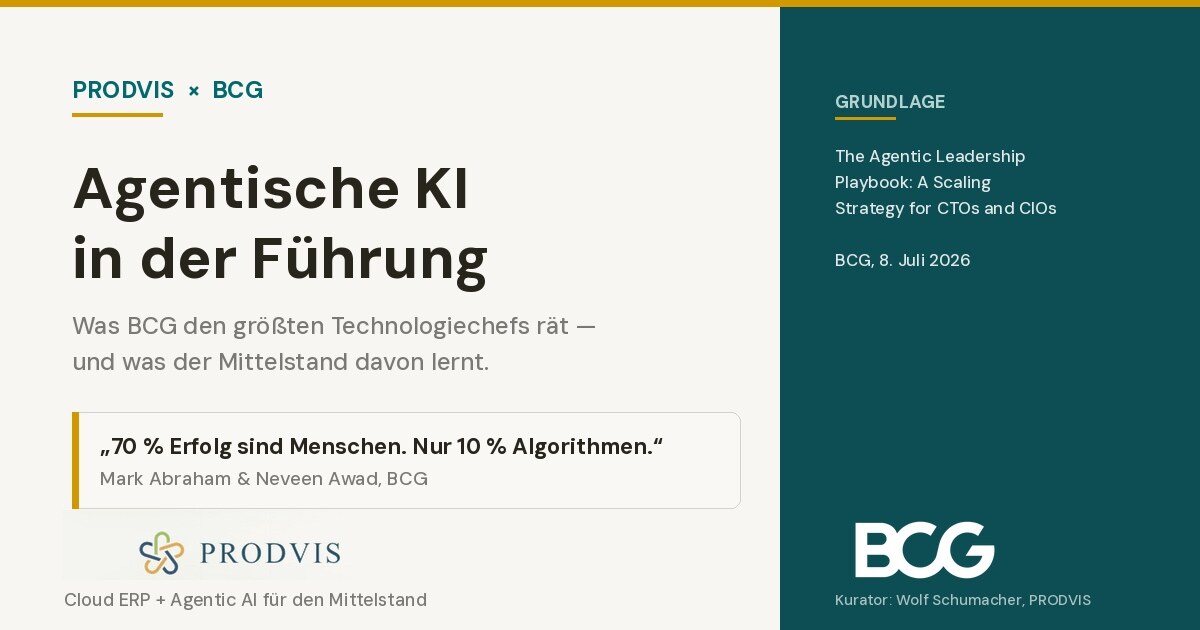
The strongest sentence in the BCG conversation is this: 70% of success is people and change. 20% is data and technology. Only 10% is algorithms.
That matches our ERP experience. Projects rarely fail because one feature is missing. They fail because roles are unclear, leadership is weak, communication is poor and a pilot is mistaken for transformation.
If the strategy only lives in the head of the managing director, it is not a strategy. It is a bet on personal continuity.
Four recommendations for managing directors
- Understand the business first. Then choose the technology. A process nobody can explain cannot be automated cleanly.
- Start with your best people. The people who really know the process belong at the table from day one.
- Define guardrails before you start. Who may do what? Which data may be used? When must a person approve?
- Say openly what you do not know yet. If a test is called a test, people can trust it. If certainty is performed, trust breaks at the first failure.
Conclusion
Agentic AI is not a project for the IT department. It is a leadership question.
Large corporations solve it with CIOs, CTOs and billion-euro budgets. Mid-market companies solve it with common sense, the right sequence, reliable ERP data and a partner who understands the technology without forgetting the business.
If you manage that, you do not need your own CTO. You need a clear head.
PRODVIS practice note
If you want to find the first useful use case for agentic AI, do not start with the tool. Start with the handovers: quote, order, purchasing, complaint, invoice. That is where you quickly see whether an agent creates speed or only adds complexity.
Read next in PRODVIS Magazine
Related articles: Agentic AI in ERP for mid-market companies, Führung neu denken: Was KI wirklich verändert, the PRODVIS AI training guide and Europe 2032.
Based on “The Agentic Leadership Playbook: A Scaling Strategy for CTOs and CIOs”, Boston Consulting Group, 8 July 2026. Curated by Wolf Schumacher, PRODVIS.